
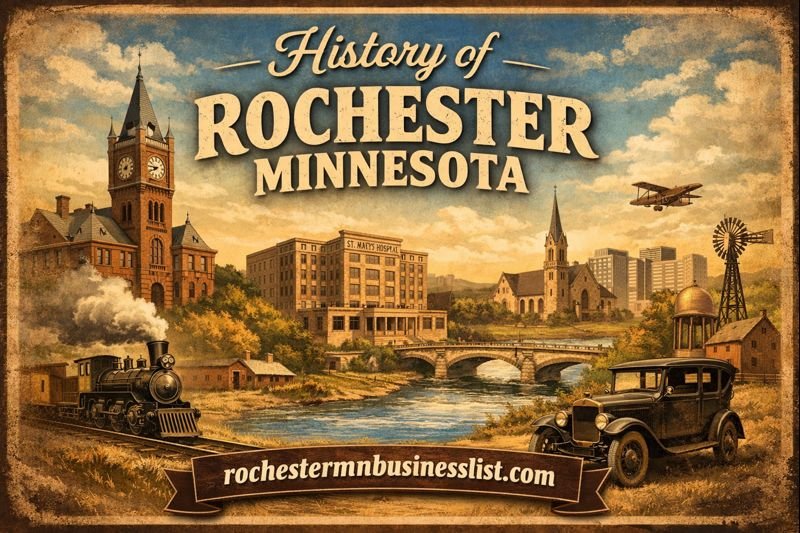
History of Rochester, Minnesota
From Prairie Crossroads to World-Renowned Medical Destination
Nestled along the rolling bluffs of the Zumbro River in southeastern Minnesota, Rochester stands today as the state’s third-largest city and home to one of the world’s most prestigious medical institutions. But long before the Mayo Clinic put this city on the global map, Rochester’s story began as a humble stagecoach stop on the vast Minnesota prairie.
Indigenous Heritage
For thousands of years before European settlement, the land that would become Rochester was home to indigenous peoples. The Dakota, Ojibway, and Ho-Chunk nations traversed and inhabited this beautiful region around the Zumbro River. Native peoples from Upper Mississippi cultures, the Northern Woodlands, and Western Prairies called this area home, drawn by its rolling hills, abundant waterways, and rich natural resources.
The earliest European explorers arrived seeking a Northwest Passage to the Pacific Ocean. French explorers Father Louis Hennepin and Pierre Le Sueur came to the Minnesota region around 1660, followed later by English explorers like Jonathan Carver who paddled their birch bark canoes up the Mississippi River or across Lake Superior.
The Founding of Rochester
Under a treaty with the U.S. government concluded in 1853, the Dakota/Sioux Indians relinquished the area that would include Rochester to the Territory of Minnesota. The following year, on July 12, 1854, George Head and his family laid claim to land that now forms part of Rochester’s central business district.
George Head, an English-born settler from Rochester, New York, built a log cabin known as “Head’s Tavern” and named the new settlement after his hometown. The location was strategically positioned along the Dubuque Trail, a key stagecoach route connecting St. Paul to Dubuque, Iowa.
Located at a crossroads near the Zumbro River, travelers would stop in this area to camp and water their animals. In 1855, the territorial legislature created Olmsted County, named after David Olmsted, who was the first mayor of St. Paul. Rochester was declared the county seat and was officially incorporated as a city on August 5, 1858—the same year Minnesota achieved statehood.
Dr. William Worrall Mayo Arrives
In 1863, a pivotal figure arrived in Rochester who would forever change the city’s destiny. Dr. William Worrall Mayo, who had emigrated from England to the United States in 1845, came to Rochester from Le Sueur, Minnesota, to serve as examining surgeon for the Union Army draft enrollment board during the Civil War.
Dr. W.W. Mayo decided he liked the growing town and moved his family to Rochester in 1864. He was 44 years old when he settled there with his wife Louise, three daughters, and his first son William James. His second son, Charles Horace, was born in Rochester in 1865, right at the end of the Civil War. Dr. Mayo established a private medical practice and became active in Rochester’s civic affairs, eventually serving as the city’s mayor.
By 1864, Rochester also became a stop on the Winona & St. Peter Railroad, later sold to the Chicago & Northwestern Transportation Company. This railroad connection provided area farmers and businesses the ability to bring their goods to a national market, helping Rochester grow into a regional urban center with a population of 5,103 by 1880.
The Devastating Tornado of 1883
August 21, 1883, began as an oppressively hot day with ominous stillness. Rochester residents had no idea how much their city was about to change. By evening, the skies darkened and winds began to roar. A massive tornado—later estimated as an F5 on the modern Fujita scale—formed and struck the northern part of Rochester with devastating force.
The tornado killed at least 37 people, injured over 200 others, destroyed 135 homes, and damaged 200 more. Mayor Samuel Whitten reported that one-third of the city had been laid waste. The tornado followed a 25-mile path, causing approximately $700,000 in damage (equivalent to nearly $15 million in modern dollars).
At the time, Rochester had no hospital—in fact, there were only three hospitals in all of Minnesota outside of Minneapolis and St. Paul. Following the disaster, a dance hall called Rommel Hall was transformed into a makeshift emergency room. Dr. William Worrall Mayo and his sons William and Charles took charge of caring for patients, assisted by Mother Mary Alfred Moes and the Sisters of St. Francis.
Birth of the Mayo Clinic
The tornado’s aftermath revealed a critical need for a permanent medical facility in Rochester. Mother Alfred Moes, a Franciscan sister and founder of the Sisters of Saint Francis of Rochester, approached Dr. Mayo with a revolutionary proposal: the Sisters would raise funds to build a hospital and supply the nursing staff if Dr. Mayo and his sons would provide the medical care.
On September 30, 1889, Saint Mary’s Hospital opened with just 27 beds. Dr. W.W. Mayo, now 70 years old, served as consulting physician while his sons Dr. Will and Dr. Charlie served as the two attending surgeons. Five Sisters made up the rest of the hospital staff.
The Mayo brothers developed what became known as the “group practice” model—a revolutionary concept where the cooperation and combined wisdom of multiple physicians proved greater than any individual practitioner. By 1904, they were operating on over 4,000 patients each year. By 1920, over 60,000 people traveled to Rochester annually for medical treatment, despite the city’s entire population being just over 13,700 residents.
In 1914, the Mayos built a permanent facility for their medical practice, officially called the Mayo Clinic. In 1919, the Mayo brothers and their wives signed a historic Deed of Gift, donating most of their life savings and all their assets—equivalent to more than $100 million today—to establish the Mayo Properties Association (later the Mayo Foundation), ensuring the clinic would continue beyond their lifetimes.
IBM Comes to Rochester
Rochester’s second major economic transformation came through an unexpected friendship forged during World War II. Thomas J. Watson Jr., who would become the second president of International Business Machines (IBM), was a pilot who struck up a close friendship with Rochester native Leland Fiegel during their military service.
When Fiegel was tragically killed in a plane crash in 1948 while returning to his Pentagon job, Watson remembered his friend. In 1956, he announced that IBM would construct a new facility in Rochester rather than competing finalist Madison, Wisconsin—in part to honor Fiegel’s memory.
IBM Rochester began with 174 employees and grew to 1,800 by the 1958 opening of the main “blue” building, designed by renowned architect Eero Saarinen. The facility eventually became IBM’s largest building under one roof at 3.6 million square feet—more than half the size of the Pentagon.
The IBM facility became a hotbed for innovation, playing key roles in developing the AS/400 computer system, the Blue Gene supercomputer, and contributing to IBM’s decades-long record for most annual U.S. patents. Rochester consistently ranked among the highest in the nation for patents filed per capita. The one-two punch of Mayo Clinic and IBM added over 20,000 people to the city’s population by 1970 and established Rochester as an economic powerhouse.
Modern Rochester
Today, Rochester is Minnesota’s third-largest city with an estimated population of over 123,000 residents and a metropolitan area of approximately 230,000. Mayo Clinic remains the city’s economic anchor, employing over 35,000 people in Rochester alone and seeing more than 1.3 million patients annually from all 50 states and 137 countries worldwide.
In 2013, the Destination Medical Center (DMC) initiative was launched—a 20-year, $5.6 billion economic development plan that represents the largest public-private economic initiative in Minnesota’s history. The project aims to transform Rochester into a global destination for health care while investing in infrastructure, research facilities, and quality of life improvements.
Rochester’s journey from a prairie stagecoach stop to a world-renowned center of medical excellence and technological innovation stands as a testament to the vision, determination, and collaborative spirit that has defined this remarkable Minnesota city for over 170 years.
The Inventor’s Velocity
Web Development & Digital Marketing
Need a professional website for your Rochester-area business? TIV360 specializes in WordPress development, local SEO, and digital marketing solutions that help Minnesota businesses thrive online.
Visit TIV360.com